
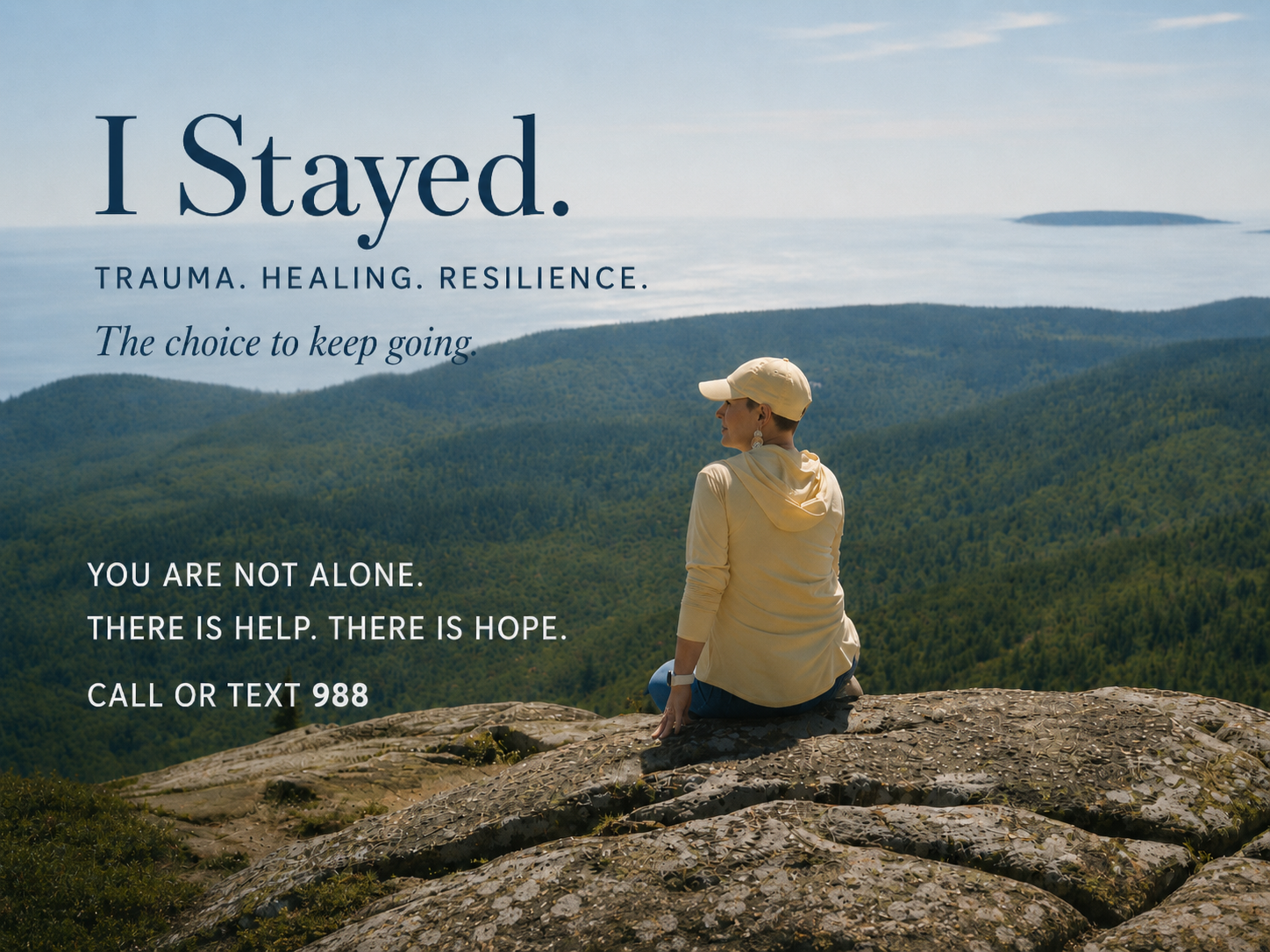
What surviving suicidal thoughts taught me about trauma, healing, and choosing to keep going.
Content note: This article discusses suicidal thoughts, trauma, and mental health. Please take care while reading. If you are struggling, help is available. In the U.S., call or text 988 to reach the Suicide & Crisis Lifeline.
There have been three significant moments in my life when I could have died by suicide. Three moments when the rest of the world seemed to go completely silent, when the pain became louder than everything and everyone telling me to hold on. For a long time, I carried shame about those moments.
I was ashamed that my mental health had reached a place where suicide was no longer just a fleeting thought. I was embarrassed that I hadn’t been able to simply push the thoughts away, tell myself to be stronger, and move forward. Because I didn’t just think about dying. I made plans.
And perhaps one of the hardest things for me to admit is that there were moments afterward when I actually considered myself a coward for not following through with them. I understand that differently now.
September is Suicide Prevention Month, and I believe one of the most important things those of us who have lived through suicidal thoughts can do is talk about what they actually look and feel like. Not because sharing our stories is easy.
It isn’t.
Suicide carries an extraordinary amount of silence with it. Shame. Fear. Judgment. The worry that people will see us differently once they know just how dark things became. So we tuck those experiences away. We survive them, but sometimes we never really speak about them. And when we don’t talk about what happens in those darkest moments, the people experiencing them now can be left believing they are the only ones who have ever felt that way. I know they aren’t.
Because I was one of them.
Three times.
⸻
I can’t honestly say when the switch flipped and the intrusive thoughts became a ticking clock inside my brain. Minutes began to feel like hours. I would stare blankly into space, bargaining with myself that this was not the minute I would end my life.
Not now.
Not yet.
But eventually, the bargaining no longer felt like a game I could win. If I chose life, the trauma was still there. If I chose death, I believed the hurt would finally stop — but I would leave behind the people I loved most, knowing that I had chosen to leave them. That is one of the most difficult things about being so deeply buried beneath trauma: you stop being able to see the sunshine, even when everyone around you still can. You learn how to plaster a smile across your face while silently falling apart underneath it. You continue conversations. You show up. You laugh when you are supposed to laugh. And all the while, something inside you is quietly dying. Eventually, you can begin to believe that your life no longer has a purpose. When I was diagnosed with cancer and lupus, knowing there was no cure waiting for me, I still knew with certainty that I wanted to live. I wanted to see my daughter graduate from school. I wanted to watch her get married. I wanted to meet her babies someday. And I knew the hand I wanted to hold for the rest of my life was my husband’s. Those things gave me reasons to fight, day after day.
But when I was in the deepest parts of my trauma, even those reasons became difficult to reach. My thinking became so distorted by pain that I began to believe my death might somehow become a rebirth for the people I loved most. In my mind, I wasn’t abandoning them. I believed I would be doing them a favor.
That is what suicidal thinking did to me. It took everything I knew to be true — that I was loved, that I mattered, that my absence would leave an unimaginable hole — and convinced me of the exact opposite.
⸻
The contradiction is something I understand now, but I couldn’t see then. I had spent years fighting illnesses that threatened my life, yet trauma had somehow convinced me that the life I had fought so hard to keep was no longer worth protecting. I understand now how deeply trauma can distort the way we think. For me, I don’t believe I truly wanted my life to end.
I wanted the pain to end.
I wanted the noise in my head to stop.
I wanted relief from analyzing every mistake, every misstep, every conversation, every wound I couldn’t seem to put down.
I wanted to stop carrying the people and situations that had hurt me so deeply that I could no longer see myself clearly.
And somewhere inside that pain, I stopped believing I was worth fighting for.
That realization is especially difficult for me because I had always known myself as the woman who lifted other people up. The woman who championed health and wellness. The woman who looked for solutions and refused to stop until she found one.
My motto had always been: “Every day may not be good, but there is something good in every day.” But I reached a place where I didn’t believe my own words anymore. I felt disconnected from everything I thought made me who I was. I have always struggled deeply with injustice. I’m a Libra, and anyone who knows me well knows how strongly I believe in balance, fairness, and the idea that somehow the universe eventually makes things right. I am also a deeply spiritual person. But during that period of my life, everything I believed seemed to collapse at once. I felt foolish for having believed so strongly that good would eventually win, that doing the right thing mattered, that justice would somehow prevail.
Because from where I was standing, justice hadn’t prevailed.
Anger had.
Pain had.
And I was so angry, so hurt, and so completely crushed that I could no longer see a life worth living on the other side of it. I could no longer see a life worth fighting for.
And yet, somehow, I stayed.
⸻
In those moments, my fear of leaving my loved ones with the pain of my absence became stronger than the pain telling me to disappear. Guilt took over. Fear took over. And I took my foot off the gas. I pulled over.
And I cried.
I cried for myself. I cried for them. And I cried for the little girl inside me who had spent so much of her life simply wanting to be loved and understood. She wanted acceptance for everything she was — and even for all the things she could never be.
I picked up my phone and began scrolling through my photos.
My daughter.
My husband.
My parents.
And then I saw myself.
I saw the smile of a woman who had once believed she was brave. A woman who had fought for her life, who wanted to make a difference in the world, and who desperately wanted other people to feel seen. I stared at her and wondered:
Was she still in there?
Could I still be that woman?
Could I become an even better version of her?
There was only one way I would ever know.
I had to stay.
Because if I decided that my life was no longer worth living, I would never get the chance to find out.
⸻
I stayed. But staying and healing were not the same thing.
When I walked into our bedroom that night, I didn’t have to admit what I had almost done. My husband knew. The look of terror on his face is something I will never forget. I had ignored his calls that night, but every time his name and face appeared on my phone, something pulled me back toward our life.
Toward him.
Toward our daughter.
Toward our cute little puppy.
Our family was small, but I had always considered us mighty. We had been through so much together.
And somehow, this life I had fought so hard to stay in had almost disappeared because I had spent too long believing I could push my mental health aside and keep going. I finally understood that I couldn’t. If I didn’t begin caring for that part of myself with the same urgency I had given my physical health, I was never going to truly heal.
Cancer was still there.
Lupus was still there.
The trauma was still there.
The cruel things people had said about me, accused me of, or chosen to believe about me were still there.
None of that disappeared simply because I had decided to stay. So I had another decision to make.
Did I believe those things defined me? Or could I look into the mirror and begin searching for the woman underneath all of that pain? Deep inside, I knew she was still there. The woman who wanted to be loved, accepted, and respected. The woman who wanted to help other people through their own healing. The woman who wanted to make a difference. The woman who wanted people to know they are not alone.
Finding a new therapist was at the top of my list the next morning. And slowly, I began to heal. I began uncovering the things I had spent so much time hiding from. I began facing the trauma that had changed me instead of pretending I could simply outrun it.
⸻
Healing is not linear. And I will never tell you that working through pain is easy.
It isn’t. There are still setbacks. There are still difficult days. There are still moments when thoughts I believed I had buried try to find their way back to the surface. The difference now is that I have tools. I have resources. And yes, I have resilience. I know how to reach for help. I know how to recognize when my thinking is taking me somewhere dangerous. And I know that a terrible moment does not have to become the ending of my story. So I continue to show up for my life.
Cracks and all.
I continue working through the thoughts that tell me I am not enough. I continue challenging the parts of myself that want to sabotage everything I have fought so hard to rebuild. And I continue repeating the words I once stopped believing: “Every day may not be good, but there is something good in every day.” Some days, finding that something takes more effort than others. But I am still here to look for it.
⸻
If you are reading this from inside your own dark moment Please tell someone. You do not need to make your pain understandable before you deserve help. You do not need to have the right words. You do not need to wait until things become unbearable. Let someone into the silence. You are worth staying for, even on the days when your own mind makes that impossible to believe.
You are not alone.
xoxo-Fab
If you are in the United States and experiencing suicidal thoughts or emotional distress, call or text 988 to reach the Suicide & Crisis Lifeline. If you are in immediate danger, call 911 or go to your nearest emergency department.